الصومال والتحديات الاقتصادية: دراسة حول استغلال الموارد الطبيعية وتخفيف حدة الفقر
SOMALIA AND ECONOMIC CHALLENGES: A STUDY ON NATURAL RESOURCE EXPLOITATION AND POVERTY ALLEVIATION
DOI:
https://doi.org/10.33102/48wets46Keywords:
Somalia, economy, challenges, exploitation, poverty, al-Ṣūmāl, al-Iqtiṣād, at-Taḥaddiyāt, Istiġlāl, al-FaqrAbstract
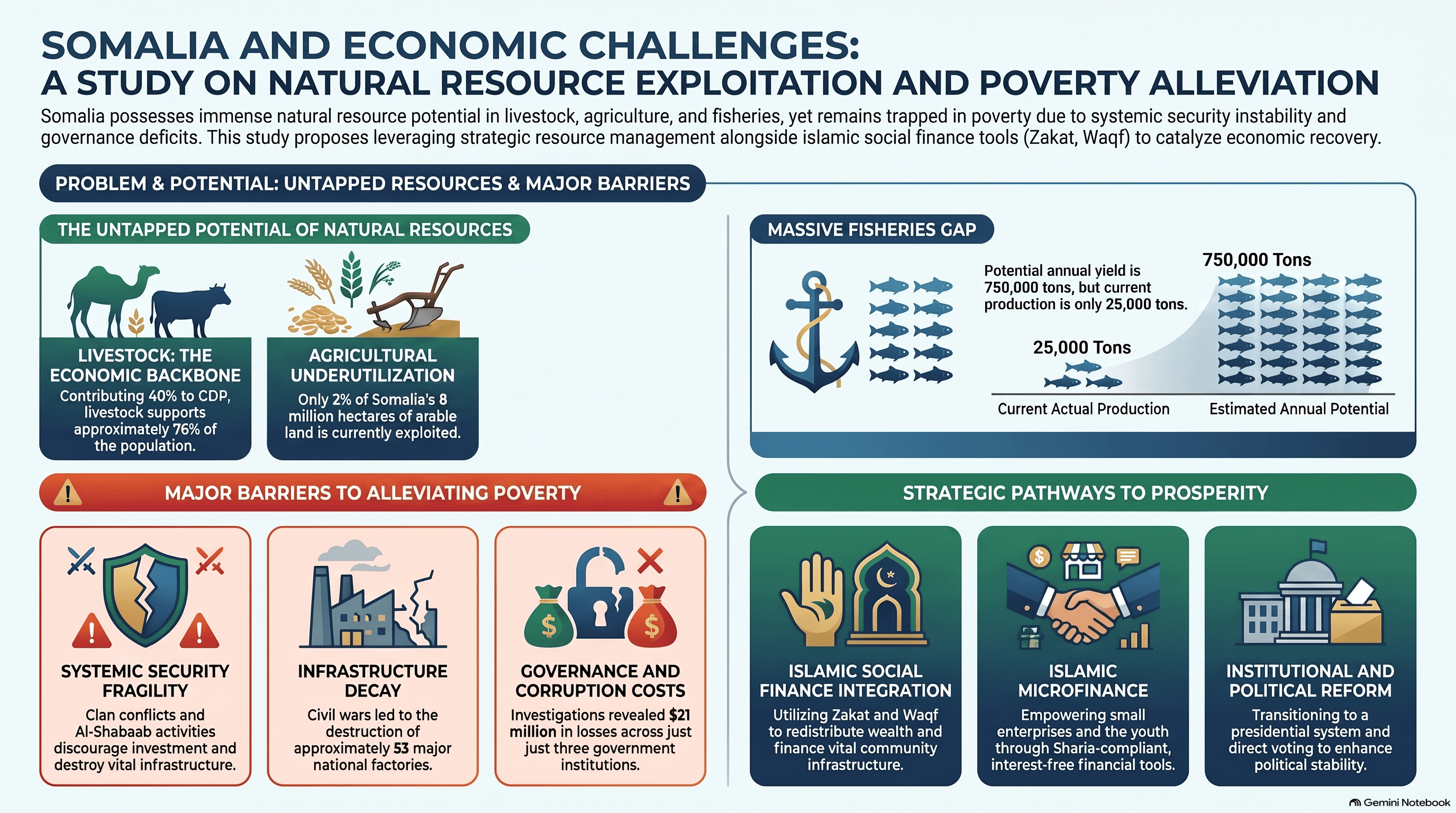
This study examines the critical economic challenges confronting Somalia and evaluates strategies to leverage its vast, unexploited natural resources—including livestock, agriculture, fisheries, and minerals—for sustainable socio-economic development. The core problem driving this research is systemic security instability, primarily fueled by clan conflicts, political fragility, and armed groups such as Al-Shabaab, which has severely disrupted infrastructure, discouraged foreign investment, and exacerbated extreme poverty. Grounded in the economic principle that capital requires a secure environment to thrive, this paper aims to analyze the interplay between political stability, resource management, and social protection mechanisms. Methodologically, it employs a combined qualitative descriptive-analytical framework: the descriptive approach diagnoses current socio-economic vulnerabilities, while the analytical framework assesses resource exploitation viability alongside Islamic social finance tools. The main findings indicate that while traditional sectors remain constrained by security threats and governance deficits, integrating Islamic economic instruments—specifically Zakat, Waqf, and Islamic microfinance—offers a viable, transformative pathway to redistribute wealth, finance infrastructure, and empower small enterprises. Globally, this research holds significant relevance as a vital case study on conflict-affected and fragile states, demonstrating how Islamic social finance and strategic resource governance can serve as an innovative model for poverty alleviation and post-conflict economic recovery in similar developing nations. Ultimately, the study concludes that achieving long-term national prosperity requires unified political reforms, anti-corruption measures, and institutionalized resource frameworks.
ملخّص البحث
تهدف هذه الدراسة إلى بحث التحديات الاقتصادية الحرجة التي تواجه جمهورية الصومال، وتقييم الاستراتيجيات الكفيلة بالاستغلال الأمثل لمواردها الطبيعية الهائلة غير المستغلة—بما في ذلك الثروة الحيوانية والزراعية والسمكية والمعدنية—لتحقيق التنمية الاجتماعية والاقتصادية المستدامة والحد من الفقر. وتكمن المشكلة المحورية التي تتناولها الدراسة في حالة عدم الاستقرار الأمني الهيكلي الناتج عن النزاعات القبائلية والهشاشة السياسية، فضلاً عن تهديدات الجماعات المسلحة كحركة الشباب؛ وهي عوامل أدت إلى تدمير البنية التحتية، وإعاقة الاستثمار الأجنبي، وتفاقم الفقرقعقع. وانطلاقاً من المبدأ الاقتصادي الذي يقر بأن رأس المال يتطلب بيئة آمنة للنمو، تسعى هذه الدراسة إلى تحليل التداخل بين الاستقرار السياسي، وإدارة الموارد الطبيعية، وآليات الحماية الاجتماعية. ولتحقيق هذه الأهداف، اعتمد الباحثان المنهج الكيفي الوصفي التحليلي؛ حيث خُصص المنهج الوصفي لتشخيص الأوضاع الاقتصادية والمعيشية وهشاشة المجتمع، بينما أُعين المنهج التحليلي لتقييم جدوى استغلال الموارد الطبيعية وأدوات التمويل الاجتماعي الإسلامي. وأظهرت أبرز نتائج الدراسة أنه في ظل القيود التي تفرضها التهديدات الأمنية وضعف الحوكمة على القطاعات التقليدية، فإن دمج أدوات الاقتصاد الإسلامي—ولا سيما الزكاة والوقف والتمويل الأصغر الإسلامي—يمثل مساراً استراتيجياً لإعادة توزيع الثروة، وتمويل البنية التحتية، ودعم المشروعات الصغيرة والمتوسطة. وتكتسب هذه الدراسة أهمية عالمية باعتبارها حالة دراسية مرجعية للدول النامية المتأثرة بالنزاعات والهشاشة، حيث تقدم نموذجاً مبتكراً لكيفية توظيف التمويل الاجتماعي الإسلامي والحوكمة الرشيدة للموارد في تحقيق التعافي الاقتصادي والحد من الفقر. وتخلص الدراسة إلى أن تحقيق الرفاه الاقتصادي والاستقرار وطني طويل الأجل يتطلب إصلاحات سياسية شاملة، ومكافحة الفقر والرعاية المؤسسية لإدارة الموارد.
Downloads
References
Adam, A. A. F., Saleh, A. O. H., & Sharofiddin, A. (2024). Islamic microfinance in Somalia: Challenges, opportunities, and practices. Al-Qanatir International Journal of Islamic Studies, 33(4), 174–184.
Al-Jazeera. (2014, July 23). “Reditus industriarum parvarum in Somaliam”. https://www.aljazeera.net/ebusiness/2014/7/23
Al-Jazeera. (2014, October 17). “Impactus revitalizationis terrarum sterilium in progressu: Studium applicatum in Somalia”. https://www.aljazeera.net/ebusiness/2014/10/17
Al-Jazeera. (2017). “Fames in Somalia post siccitatem pastae”. https://www.aljazeera.net/encyclopedia
Al-Jazeera. (2017, March 6). “Siccitas et deterioratio securitatis”. https://www.aljazeera.net/news/2017/3/6/
Alsomal. (2017). “Farmajo: Somalia dives est mineralium et longissimum orarium in Africa habet”. https://alsomal.net
Alsomal. (n.d.). “Sector agriculturae in Somalia: Opportunitates et provocationes”. https://alsomal.net
Arabic Democratic Center for Strategic, Economic and Political Studies. (2018). “Somalia et minae ad securitatem nationalem Aegypti in regione Cornu Africae”. https://democraticac.de/
Atoum, H. A. (2020). “Structurae contractuum pecuniariorum apud Argentariam Salam in Somalia: Studium iurisprudentiae applicatum”. https://e3arabi.com/
Laha Online. (n.d.). “Fames in Somalia: Causae et effectus”. https://www.lahaonline.com
Mohamud, Z. A. M., & Mahadi, N. F. (2023). Establishment of waqf institutions to alleviate poverty in Somalia. Journal of Islamic Philanthropy & Social Finance, 1(1), 1-12.
National Reports. (n.d.). Somalia stabilitatem quaerit. Social Watch, 86.
Nova Somalia. (n.d.). “Sector pecudum in Somalia: Opportunitates et provocationes”. https://alsomal.net
Nur, A. M., & Bin-Nashwan, S. A. (2022). The potential of cash waqf for poverty alleviation in Somalia. Journal of Islamic Accounting and Business Research, 222-234.
Politics-DZ. (2021). “Lectio status in Somalia in Cornu Africae et eius impactus in securitatem in regione Maris Rubri”. https://www.politics-dz.com
Sulub, Y. A. (2022, November 28–30). Exploring Islamic social finance practices in Somaliland: Issues and prospects. UUM International Qualitative Research Conference (QRC 2022), Virtual Conference.
Turk Press. (2018). “Colloquium cum legato Somaliensi Ancyrae”. https://www.turkpress.co/node/
Xalane, A. (2019). The role of Islamic microfinance for poverty alleviation in Mogadishu, Somalia (Unpublished master's thesis). University of Mogadishu.
Downloads
Published
Issue
Section
License
Copyright (c) 2026 Muktar Shek Abdurahiman, Mahmoud Mohamed Ali Mahmoud Edris

This work is licensed under a Creative Commons Attribution-NonCommercial-ShareAlike 4.0 International License.