PENERBITAN DIGITAL DAN PENGHARAMAN SIBER DI MALAYSIA: CABARAN UNDANG-UNDANG DALAM ERA MEDIA BAHARU
DIGITAL PUBLISHING AND ONLINE CENSORSHIP: LEGAL CHALLENGES IN THE NEW MEDIA ERA
DOI:
https://doi.org/10.33102/z82je741Keywords:
Publication bans, digital publishing, cyber law, freedom of speech, communications and multimedia, Malaysia, pengharaman penerbitan, penerbitan digital, undang-undang siber, kebebasan bersuara, komunikasi dan multimediaAbstract
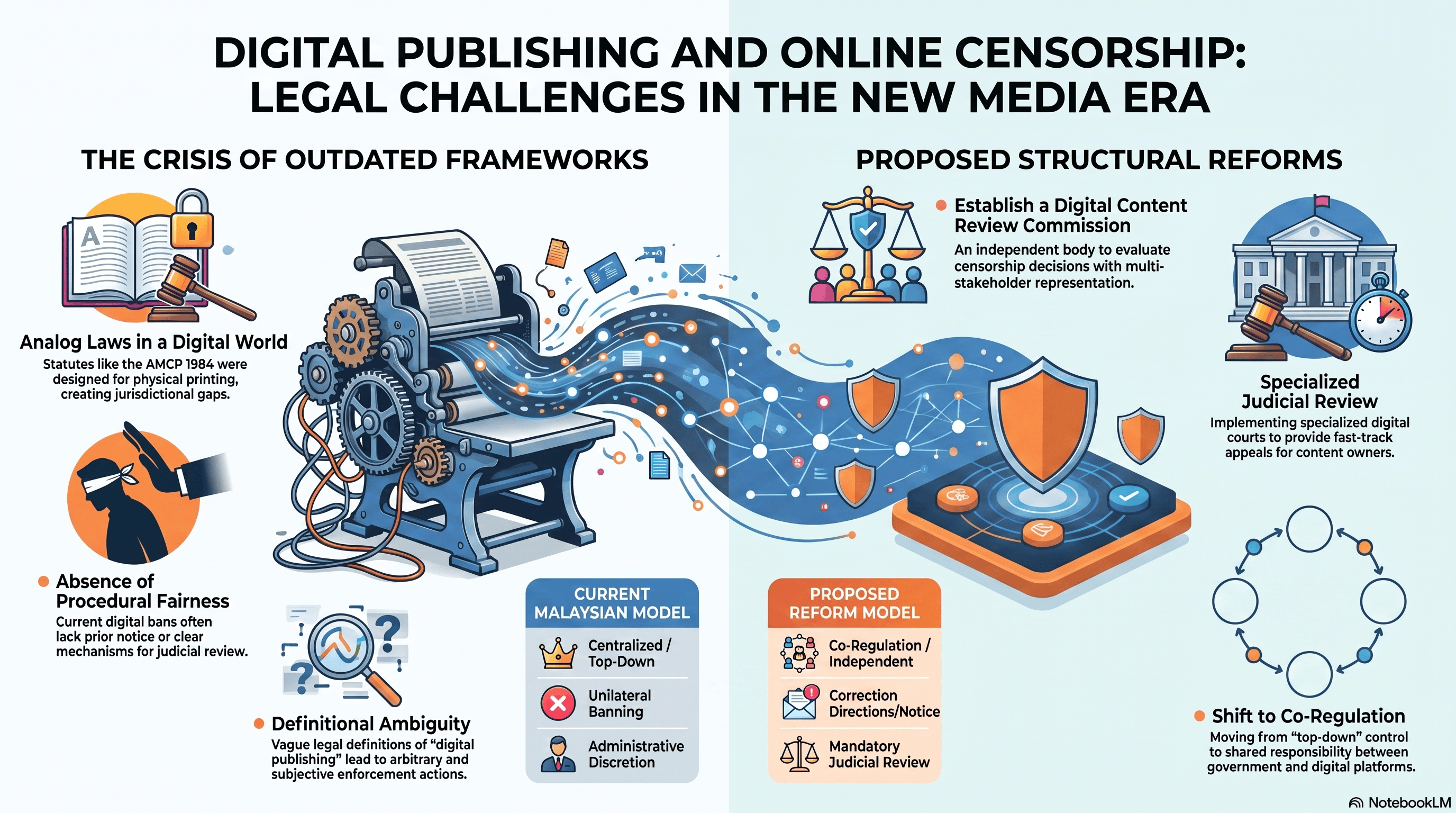
The rapid advancement of digital media and online platforms has transformed the traditional publishing landscape and introduced novel challenges to the Malaysian legal system. This article examines the issue of publication bans within the digital context that commonly referred to as cyber banning which has become increasingly prevalent through restrictions on websites, social media, and digital content. Employing a qualitative doctrinal legal research approach, this study conducts a documentary analysis of existing statutory frameworks, specifically the Printing Presses and Publications Act 1984 and the Communications and Multimedia Act 1998, complemented by a comparative analysis of selected ASEAN nations. The findings reveal that the current legal framework predominantly retains a centralized control model, thereby creating tension with the constitutional guarantee of freedom of speech under Article 10 of the Federal Constitution. Furthermore, the study identifies several critical challenges, including definitional ambiguities, jurisdictional limitations, a lack of transparency in administrative decisions, and the risk of suppressing digital media freedom. Consequently, this article proposes comprehensive legal reforms in Malaysia, including the introduction of explicit judicial review mechanisms, the establishment of a Digital Content Review Commission, and the formulation of cyber guidelines aligned with human rights and digital democracy principles.
ABSTRAK
Perkembangan pesat media digital dan platform dalam talian telah mengubah landskap penerbitan tradisional serta mencetuskan pelbagai cabaran baharu kepada sistem perundangan di Malaysia. Artikel ini bertujuan meneliti isu pengharaman penerbitan dalam konteks digital, atau dikenali sebagai pengharaman siber, yang kini semakin meluas melalui sekatan terhadap laman sesawang, media sosial, dan kandungan digital. Kajian ini menggunakan pendekatan kualitatif perundangan (doctrinal legal research) melalui kaedah analisis dokumen terhadap peruntukan undang-undang sedia ada, khususnya Akta Mesin Cetak dan Penerbitan 1984 (AMCP) serta Akta Komunikasi dan Multimedia 1998 (AKM), di samping analisis perbandingan dengan beberapa negara ASEAN. Hasil kajian menunjukkan bahawa kerangka undang-undang sedia ada masih mengekalkan pendekatan kawalan berpusat yang mencetuskan konflik dengan jaminan kebebasan bersuara di bawah Perkara 10 Perlembagaan Persekutuan. Kajian turut mengenal pasti beberapa cabaran kritikal termasuk kekaburan definisi, had bidang kuasa, isu ketelusan keputusan pentadbiran, serta risiko penindasan terhadap media digital. Oleh itu, artikel ini mencadangkan agar undang-undang Malaysia diperkemas menerusi pengenalan mekanisme semakan kehakiman yang lebih jelas, penubuhan Suruhanjaya Semakan Kandungan Digital, serta penggubalan garis panduan siber yang menepati prinsip hak asasi manusia dan demokrasi digital.
Downloads
References
Alias, M. A. A., Wan Ismail, W. A. F., Baharuddin, A. S., Hashim, H., & Mallow, M. S. (2025). An appraisal of the legal framework governing the admissibility of electronic documents as evidence in Malaysian Shariah courts: Current practices and future legal directions. IIUM Law Journal, 33(2), 69–108. https://doi.org/10.31436/iiumlj.v33i2.1077
ARTICLE 19. (2023a). “Freedom of expression and digital regulation in Southeast Asia: Policy brief”. https://www.article19.org/
ARTICLE 19. (2023b). “Freedom of expression online: Regional perspectives in Asia”. https://www.article19.org/
Barker, T. (2019). The moral and social regulation of the Indonesian internet: Analyzing the ITE Law and digital censorship. Journal of Southeast Asian Studies, 50(2), 234–251.
Mohammed Na'aim, M. S., Mohd Zahir, M. Z., Rajamanickam, R., Dahlan, N. K., & Hashim, H. (2025). Analysing ministerial reasons for banning books under the Printing Presses and Publications Act 1984. Malaysian Journal of Syariah and Law, 13(2), 401–412.
Rahman, A. H., & Lim, J. W. (2021). Digital censorship and administrative discretion under the Communications and Multimedia Act 1998. Malayan Law Journal, 7(2), 45–62.
Rahman, N., & Lim, J. (2021). Censorship and digital governance in Malaysia. Journal of Media Law, 14(2), 211–229.
Salleh, M. (2019). Freedom of expression and publication control in Malaysia. Malayan Law Journal, 5(1), 65–82.
Salleh, N. M. (2019). Media law and censorship in Malaysia: Revisiting the Printing Presses and Publications Act 1984. Journal of Malaysian Legal Studies, 12(1), 1–20.
Tuan Ibrahim, T. M. F. H., Baharuddin, A. S., Alias, M. A. A., & Mohd Hakim, M. Z. Z. (2026). Keperluan prosedur forensik digital dalam pembuktian jenayah siber di Mahkamah Syariah: Isu dan cabaran. UMRAN - Journal of Islamic and Civilizational Studies, 13(2), 241–258. https://doi.org/10.11113/umran2026.13n2.849
UNESCO. (2022a). “Guidelines for regulating digital platforms: A human rights-based approach”. UNESCO Publishing. https://unesdoc.unesco.org/
UNESCO. (2022b). Internet universality indicators: Malaysia report. UNESCO Publishing.
United Kingdom. (2023). Online Safety Act 2023. Her Majesty's Stationery Office.
Downloads
Published
Issue
Section
License
Copyright (c) 2026 nur khalidah nur khalidah dahlan, Mohd Zamre Mohd Zahir , Ramalinggam Rajamanickam

This work is licensed under a Creative Commons Attribution-NonCommercial-ShareAlike 4.0 International License.