MARINE TOURISM IN MALAYSIA: ENSURING SUSTAINABLE DEVELOPMENT AND CONSERVATION
DOI:
https://doi.org/10.33102/z8fk9r40Keywords:
Marine tourism, sustainable development, conservation law, MalaysiaAbstract
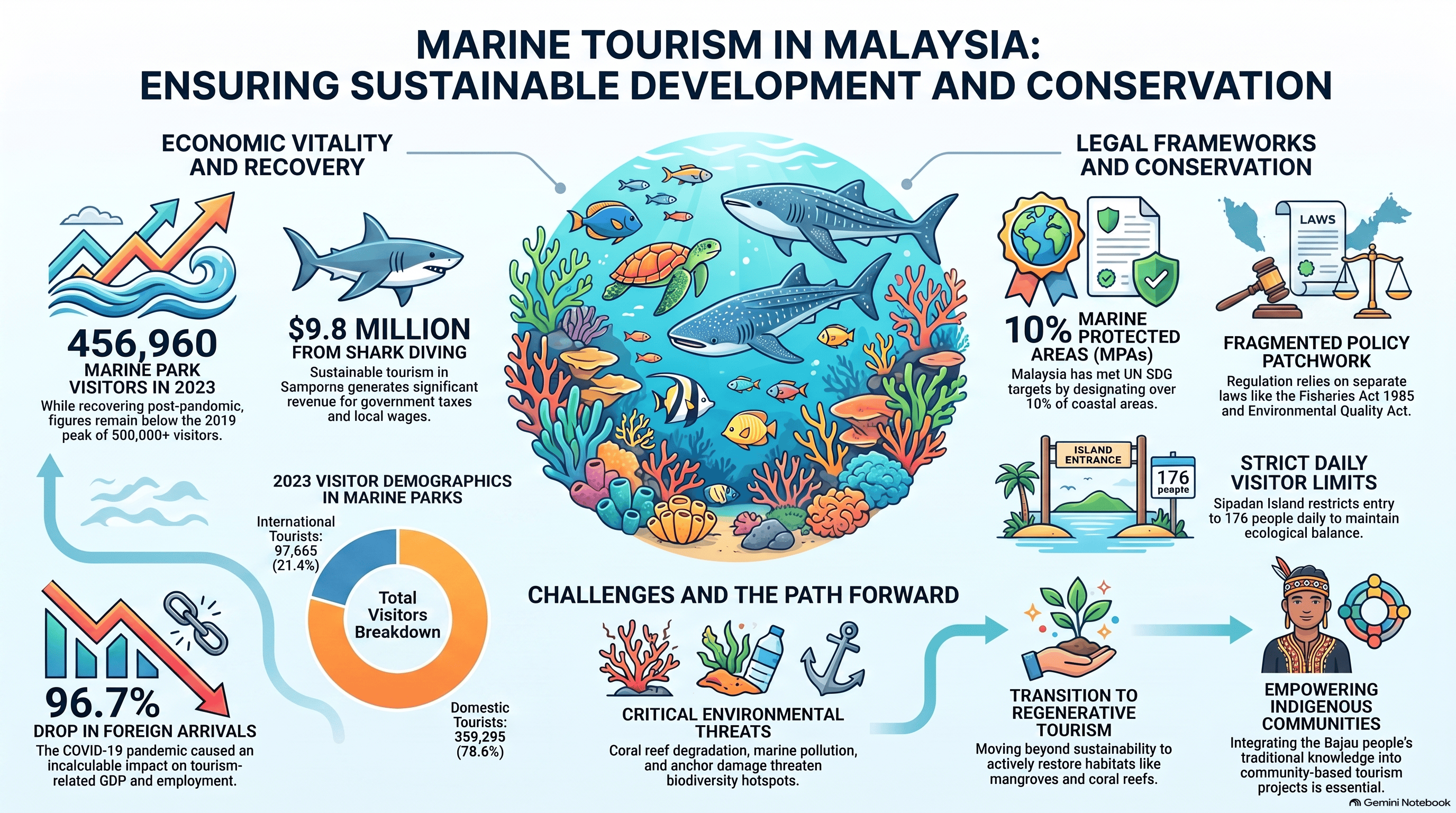
Marine tourism plays a vital role in Malaysia’s economic development, drawing both domestic and international visitors to its biodiverse coastal and island ecosystems. However, this rapid growth raises serious concerns regarding environmental sustainability, including coral reef degradation, marine pollution, and overexploitation of resources. This paper examines the legal and policy framework governing marine tourism in Malaysia, highlighting key legislation, including the Environmental Quality Act 1974, the Fisheries Act 1985, and the Exclusive Economic Zone Act 1984, as well as relevant state enactments in Sabah and Sarawak. It further examines how international commitments, particularly the United Nations' Sustainable Development Goals and the Coral Triangle Initiative, influence domestic conservation strategies. Through zoning, licensing, and enforcement mechanisms, Malaysia seeks to balance economic benefits with environmental protection. The paper also assesses the role of sustainable and regenerative tourism practices in ensuring long-term ecological and socio-economic viability, including community-based initiatives and conservation-linked tourism such as shark diving in Semporna. Despite these efforts, challenges persist in the form of weak inter-agency coordination, enforcement gaps, limited awareness, and uneven benefit distribution among coastal communities. The study concludes by emphasizing the need for integrated governance, community empowerment, and environmental education to achieve sustainable marine tourism that supports both ecological resilience and inclusive development.
Downloads
References
Bernama. (2022). Domestic tourism spending in 2021 dropped 54.5 percent to RM18.4 billion. New Straits Times.
Che Leh, F., Mohd Isa, N. K., Ibrahim, M. H., Ibrahim, M., Yunos, M. Y. M., & Ibrahim, J. A. (2021). Low-carbon tourism approach as an alternative form for tourism development: A review for model development. Pertanika Journal of Social Sciences and Humanities, 29(4), 2431–2451.
Crabtree, A. (2007, November). Coastal/marine tourism trends in the Coral Triangle and strategies for sustainable development interventions. Center on Ecotourism and Sustainable Development; World Wildlife Fund.
Dahlan, N. K., & Affendy, H. (2025). Unveiling holiday package scams: A legal analysis under Malaysian law. International Journal of Law, Government and Communication, 10(41), 397–408.
Department of Fisheries Malaysia. (2024). Perangkaan tahunan pelancongan Taman Laut Malaysia 2019-2023 (Annual tourism statistics for Malaysian Marine Parks 2019-2023). Ministry of Agriculture and Food Security.
Din, B. H., Habibullah Shah, M. S., & Choo, W. C. (2014). The impact of sustainable tourism and good governance on biodiversity loss in Malaysia. SHS Web of Conferences, 12, Article 01063. https://doi.org/10.1051/shsconf/20141201063
Economic Planning Unit. (2021). “Malaysia Sustainable Development Goals roadmap phase I (2016-2020)”. Prime Minister's Department Malaysia. https://www.epu.gov.my/en/sustainable-development-goals
ERIA. (2021). Malaysia's blue economy: Position, initiatives, and challenges. Economic Research Institute for ASEAN and East Asia.
Fong, D. R. (2023). Semporna islanders working hard to restore ailing coral reefs. The Star.
Ghazali, F., Talaat, W. I., Rahman, A., & Rusli, H. (2021). Malaysian efforts in combating IUU fishing: A legal and policy review. In ASEAN international law (pp. 415–426). Springer Nature Singapore.
Hamzah, A., Arifin, A., Abdullah, S., Mat Som, A. P., & Junaid, I. (2024). Empowerment of coastal communities through marine tourism: A functional approach. Planning Malaysia, 22(34), 329–343. https://doi.org/10.21837/pm.v22i34.1633
International Law Editorial. (2024). “Navigating the waters: Marine tourism and regulation insights”. World Jurisprudence. https://worldjurisprudence.com/marine-tourism-and-regulation/
Islam, G. M. N., Noh, K. M., Yew, T. S., & Noh, A. F. M. (2013). Assessing environmental damage to marine protected area: A case of Perhentian Marine Park in Malaysia. Journal of Agricultural Science, 5(8), 133–140.
KASI Strategic Institute for Asia Pacific. (2020). Threats to marine ecosystem. KASI Strategic Institute for Asia Pacific.
Luković, T. (2013). Nautical tourism. CABI.
Lynch, T. P., Wilkinson, E., Melling, L., Hamilton, R., Macready, A., & Feary, S. (2004). Conflict and impacts of divers and anglers in a marine park. Environmental Management, 33(2), 196–211.
Marzo, R. R., Chen, H. W. J., Anuar, H., Abdul Wahab, M. K., Arifin, M. H. N., Ariffin, I. A., & Lin, Y. (2023). Knowledge, attitude, and practice of coral reef conservation among Terengganu community of Malaysia. Frontiers in Environmental Science, 11, 1267980. https://doi.org/10.3389/fenvs.2023.1267980
Mohd Adam, S. (2019). Impacts of ecotourism development in Tasik Kenyir on the quality of life as perceived by the local community. Journal of Sustainability Science and Management, 14(2), 114–128.
Mujahid, A. (2023). MyIMCA: Malaysia's important coastal and marine areas and global biodiversity commitments. Journal of Marine and Coastal Sustainability, 5(2), 112–126.
Orams, M. (2002). Marine tourism: Development, impacts and management. Routledge.
Selamat, A. M. B., Ramdas, M., & Suhaili, M. S. (2016). The impact of tourism on the marine environment of small islands: The case of Pangkor Island, Malaysia. Journal of Modern Education Review, 6(9), 639–647. https://doi.org/10.15341/jmer(2155-7993)/09.06.2016/008
United Nations Environment Programme. (2022). “Transforming tourism in the Pan-European region for a resilient and sustainable post-COVID world”. https://wedocs.unep.org/20.500.11822/39782
Vianna, G. M. S., Meekan, M. G., Rogers, A. A., Kragt, M. E., Alin, J. M., & Zimmerhackel, J. S. (2017). Shark-diving tourism as a financing mechanism for shark conservation strategies in Malaysia (PeerJ Preprints e3481v1). https://doi.org/10.7287/peerj.preprints.3481v1
Downloads
Published
Issue
Section
License
Copyright (c) 2026 Harraveendrran A/L Ravindran, Ahmad Rafif Fakhri Mohd Sukri, Albertini Bugat Anak July, Arisha Mohd Ariff Mochtaruddin, Nur Khalidah Dahlan

This work is licensed under a Creative Commons Attribution-NonCommercial-ShareAlike 4.0 International License.