TOWARDS RESPONSIBLE ARTIFICIAL INTELLIGENCE (AI) GOVERNANCE IN THE MALAYSIAN CRIMINAL JUSTICE SYSTEM: A LEGAL AND ETHICAL APPRAISAL OF PREDICTIVE POLICING AND AI-DRIVEN SURVEILLANCE
DOI:
https://doi.org/10.33102/5ykncb04Keywords:
Artificial Intelligence (AI), predictive policing, surveillance, criminal justice, responsible AI governanceAbstract
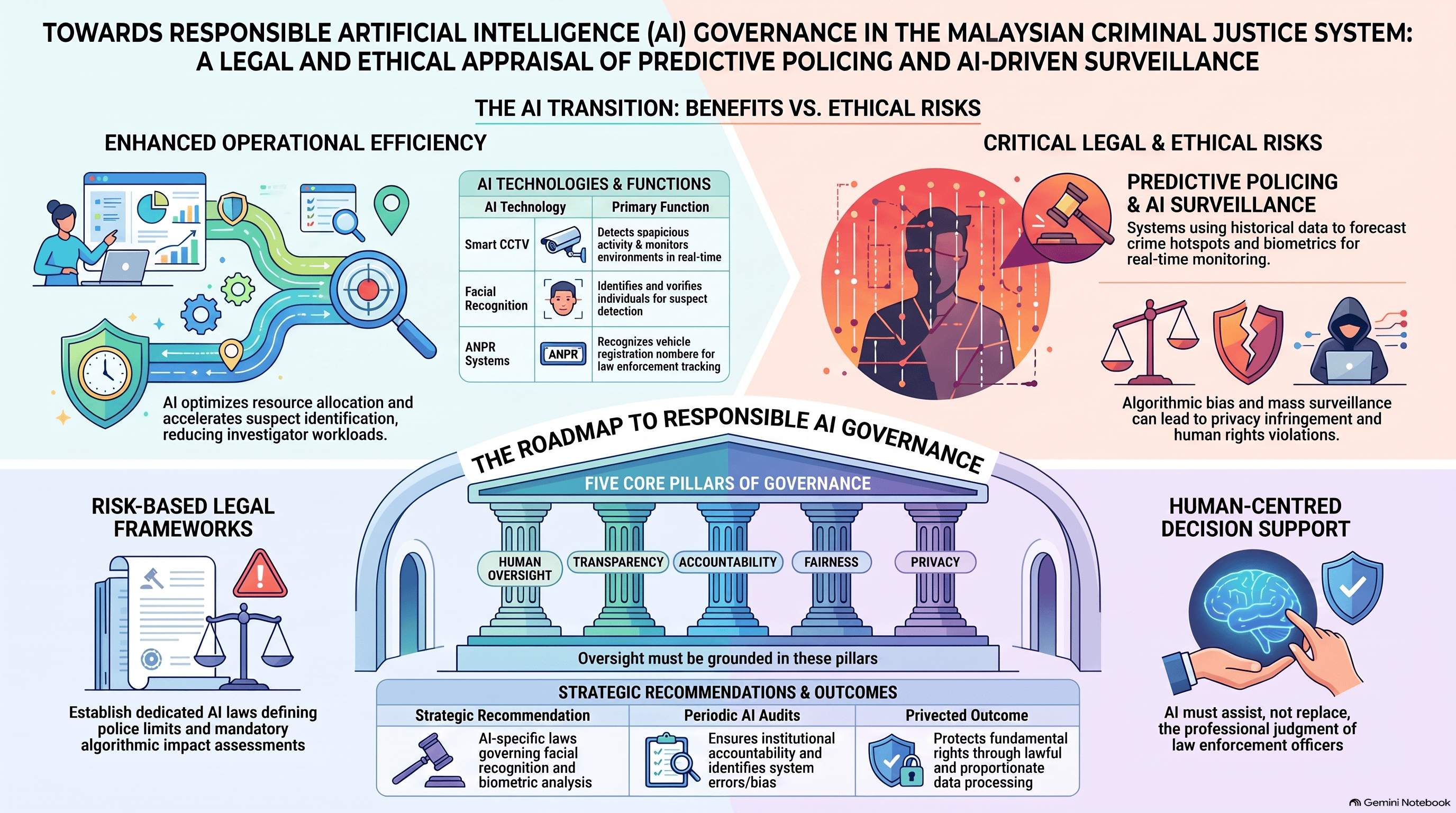
Artificial Intelligence (AI) is increasingly transforming criminal justice systems through technologies such as predictive policing, predictive crime mapping, facial recognition, and AI-driven surveillance to enhance operational efficiency and support evidence-based decision-making. However, the rapid expansion of these technologies raises critical legal and ethical concerns regarding algorithmic bias, privacy infringement, transparency, accountability, and the protection of fundamental human rights. In Malaysia, although digital transformation policies have progressed significantly, scholarly discussion concerning the governance of predictive policing and AI-driven surveillance remains relatively limited from a legal and regulatory perspective. Accordingly, this study examines the concepts of predictive policing and AI-driven surveillance, evaluates their operational benefits alongside associated legal and ethical challenges, and proposes practical recommendations for strengthening responsible AI governance within the Malaysian criminal justice system. Adopting a qualitative research design, the study utilizes document analysis for data collection. The data collected were then analysed and presented according to key subthemes. The findings indicate that AI possesses significant potential to enhance crime prevention, optimize resource allocation, improve investigative efficiency, and support law enforcement decision-making. Nevertheless, these operational advantages are accompanied by substantial legal and ethical risks, particularly concerning algorithmic bias, excessive surveillance, data privacy, and compromised accountability. To mitigate these risks, this study suggests that future implementation of predictive policing technologies in Malaysia should be guided by a comprehensive Responsible AI Governance Framework grounded in human oversight, transparency, accountability, fairness, and privacy protection. Overall, this research contributes to the scholarship on AI governance by providing an integrated legal appraisal and context-specific governance recommendations to inform future regulatory development and ethical AI implementation in Malaysia and other developing jurisdictions.
Downloads
References
Alias, M. A. A., Wan Ismail, W. A. F., Baharuddin, A. S., Hasnizam, H., Tuan Ibrahim, T. M. F. H., & Tuan Muhammad Faris Hamzi, T. M. F. H., & Mohamad Sukri, M. N. (2025). The integration of artificial intelligence (AI) into the sharīʿah judiciary: A maqāṣid al-sharīʿah approach to ethical and legal transformation. In CFORSJ Procedia, (pp. 119-127). https://alnadwah.usim.edu.my/cforsjprocedia/paper/view/204
Almasoud, A. S., & Idowu, J. A. (2025). Algorithmic fairness in predictive policing. AI and Ethics, 5, 2323–2337. https://doi.org/10.1007/s43681-024-00541-3
Almeida, D., Shmarko, K., & Lomas, E. (2022). The ethics of facial recognition technologies, surveillance, and accountability in an age of artificial intelligence: A comparative analysis of US, EU, and UK regulatory frameworks. AI and Ethics, 2(3), 377–387. https://doi.org/10.1007/s43681-021-00077-w
Barocas, S., & Selbst, A. D. (2016). Big data's disparate impact. California Law Review, 104(3), 671–732.
Braun, V., & Clarke, V. (2006). Using thematic analysis in psychology. Qualitative Research in Psychology, 3(2), 77–101. https://doi.org/10.1191/1478088706qp063oa
Chong, S. Z., & Kuek, C. Y. (2022). Facial recognition technology in Malaysia: Concerns and legal issues. In Proceedings of the International Conference on Law and Digitalization (ICLD 2022) (pp. 101–109). Atlantis Press. https://doi.org/10.2991/978-2-494069-59-6_10
Dwivedi, Y. K., Hughes, L., Ismagilova, E., Aarts, G., Coombs, C., Crick, T., Duan, Y., Dwivedi, R., Edwards, J., Eirug, A., Galanos, V., Ilavarasan, P. V., Janssen, M., Jones, P., Kar, A. K., Kizgin, H., Kronemann, B., Lal, B., Lucini, B., ... Williams, M. D. (2021). Artificial intelligence (AI): Multidisciplinary perspectives on emerging challenges, opportunities, and agenda for research, practice and policy. International Journal of Information Management, 57, 101994. https://doi.org/10.1016/j.ijinfomgt.2019.08.002
European Union. (2024). Regulation (EU) 2024/1689 laying down harmonised rules on artificial intelligence (Artificial Intelligence Act). Official Journal of the European Union.
Garvie, C., Bedoya, A. M., & Frankle, J. (2016). The perpetual line-up: Unregulated police face recognition in America. Georgetown Law Center on Privacy & Technology.
Gstrein, O. J., Bunnik, A., & Zwitter, A. (2019). Ethical, legal and social challenges of predictive policing. Católica Law Review, 3(3), 77–98.
Hutchinson, T., & Duncan, N. (2012). Defining and describing what we do: Doctrinal legal research. Deakin Law Review, 17(1), 83–119. https://doi.org/10.21153/dlr2012vol17no1art70
Jain, A. K., Ross, A., & Prabhakar, S. (2004). An introduction to biometric recognition. IEEE Transactions on Circuits and Systems for Video Technology, 14(1), 4–20.
Lim, A. C. M., Ng, L. H. X., & Taeihagh, A. (2025). Biometric data landscape in Southeast Asia: Challenges and opportunities for effective regulation. Computer Law & Security Review, 56, 106095. https://doi.org/10.1016/j.clsr.2024.106095
Mandalapu, V., Elluri, L., Vyas, P., & Roy, N. (2023). Crime prediction using machine learning and deep learning: A systematic review and future directions. IEEE Access, 11, 60153–60170. https://doi.org/10.1109/ACCESS.2023.3286344
Mehrabi, N., Morstatter, F., Saxena, N., Lerman, K., & Galstyan, A. (2021). A survey on bias and fairness in machine learning. ACM Computing Surveys, 54(6), 1–35.
Meijer, A. J., & Wessels, M. (2019). Predictive policing: Review of benefits and drawbacks. International Journal of Public Administration, 42(12), 1031–1039. https://doi.org/10.1080/01900692.2019.1575664
Ministry of Digital. (2024). National guidelines on artificial intelligence governance and ethics (AIGE). Ministry of Digital.
Mohd Nor, M. A., Mohd Tasrib, M. A., Francis, B., Hesham, N. I., & Othman, M. B. (2021). A study on the laws governing facial recognition technology and data privacy in Malaysia. Malaysian Journal of Social Sciences and Humanities, 6(10), 480–489. https://doi.org/10.47405/mjssh.v6i10.1086
Mohler, G. O., Short, M. B., Malinowski, S., Johnson, M., Tita, G. E., Bertozzi, A. L., & Brantingham, P. J. (2015). Randomized controlled field trials of predictive policing. Journal of the American Statistical Association, 110(512), 1399–1411. https://doi.org/10.1080/01621459.2015.1077710
National AI Office. (2025). “About the National AI Office (NAIO)”. https://ai.gov.my/about-naio/
National Institute of Standards and Technology. (2023). Artificial intelligence risk management framework (AI RMF 1.0). U.S. Department of Commerce.
Organisation for Economic Co-operation and Development. (2019). “OECD principles on artificial intelligence”. https://oecd.ai/en/ai-principles
Oswald, M., Grace, J., Urwin, S., & Barnes, G. C. (2018). Algorithmic risk assessment policing models: Lessons from the Durham HART model and "experimental" proportionality. Information & Communications Technology Law, 27(2), 223–250. https://doi.org/10.1080/13600834.2018.1458455
Perry, W. L., McInnis, B., Price, C. C., Smith, S. C., & Hollywood, J. S. (2013). Predictive policing: The role of crime forecasting in law enforcement operations. RAND Corporation.
Richardson, R., Schultz, J. M., & Crawford, K. (2019). Dirty data, bad predictions: How civil rights violations impact police data, predictive policing systems, and justice. New York University Law Review Online, 94, 15–55.
Saunders, J., Hunt, P., & Hollywood, J. S. (2016). Predictions put into practice: A quasi-experimental evaluation of Chicago's predictive policing pilot. Journal of Experimental Criminology, 12(3), 347–371. https://doi.org/10.1007/s11292-016-9272-0
Smith, M., & Miller, S. (2022). The ethical application of biometric facial recognition technology. AI & Society, 37(1), 167–175. https://doi.org/10.1007/s00146-021-01199-9
UNESCO. (2021). Recommendation on the ethics of artificial intelligence. UNESCO.
Valera, M., & Velastin, S. A. (2005). Intelligent distributed surveillance systems: A review. IEE Proceedings – Vision, Image and Signal Processing, 152(2), 192–204.
Downloads
Published
Issue
Section
License
Copyright (c) 2026 Mohamad Aniq Aiman Alias, Wan Abdul Fattah Wan Ismail, Ahmad Syukran Baharuddin, Hasnizam Hashim, Fareed Mohd Hassan, Tuan Muhammad Faris Hamzi Tuan Ibrahim

This work is licensed under a Creative Commons Attribution-NonCommercial-ShareAlike 4.0 International License.